

Anthropogenic activities are increasing the amount of carbon dioxide (CO2) in the atmosphere. There is mounting experimental evidence that lifetime exposur
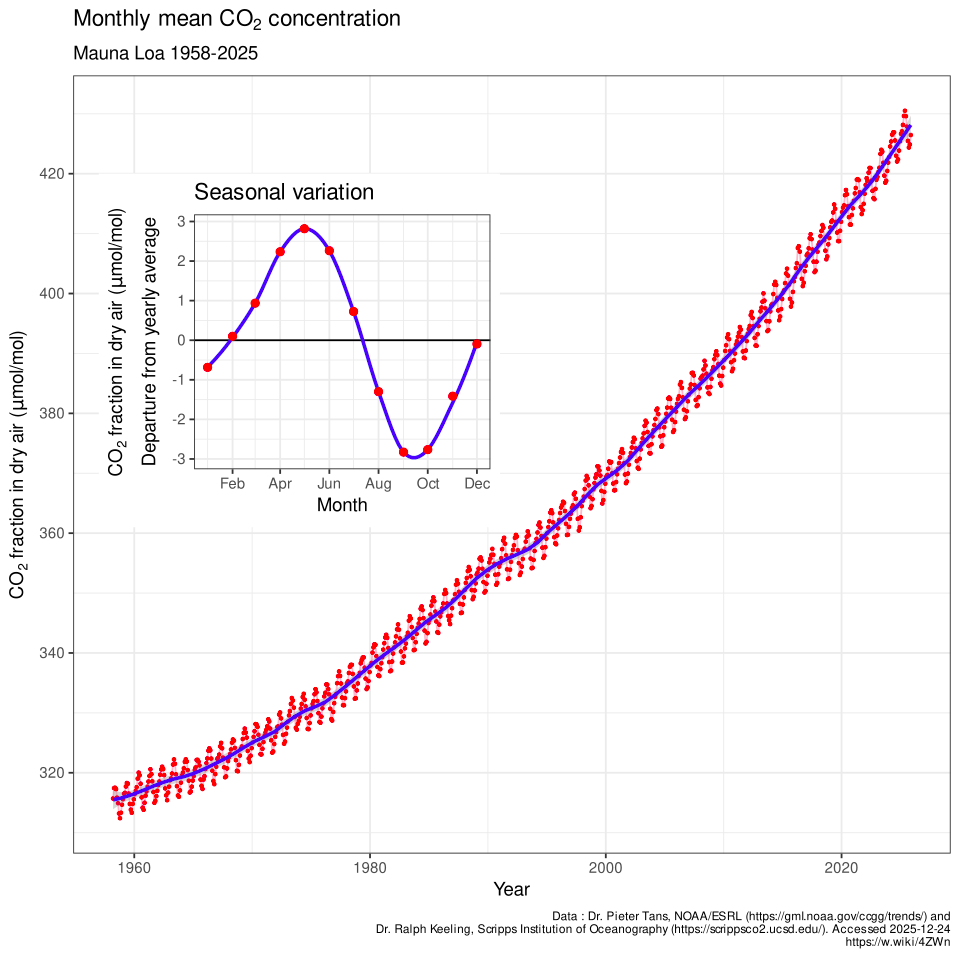
You can see the change here:
more general info: https://en.wikipedia.org/wiki/Carbon_dioxide_in_the_atmosphere_of_Earth
To make it even more scary, it is accelerating. It has increased 75 ppm in 30 years and it was 40 ppm in the first 30 years.
I mean, just the fact that we increased the ppm by ~100, or 1/3rd what it was, in just 60 years is terrifying. Let alone that it’s accelerating. And CO2 isn’t even the worst climate change gas. And there are many positive feedback loops getting exacerbated by the effects…
Good times
deleted by creator
I see this sentiment quite often, is it field-specific? Cause in physics and chemistry, starting at 0 is really not required…
In this case, the zero value is really not relevant (since no-one would ever have it anyway). It would just hide the signifcant drift over time. A good scaling here would be based on some clinically relevant interval I guess.
I agree that showing the zero level may be useful here, but… I cannot find a scientific source that shows it differently, so it’s not intentionally misleading at least. The bigger issue IMO is that it doesn’t show enough historic context (ice core data). The original article has it, or nature.org or co2science.org (though it doesn’t show the latest measurements).
This graph is from wikipedia. Feel free to fix it.
Isn’t this the opposite of truncated? They drill down each year’s cycle and show like 80 years of cycles.
The y axis doesn’t start at 0, making it look like the change has been a lot more drastic than it actually was (even though it’s still very bad). I think that’s what they’re referring to
This great news! Not just not have we an increasingly unstable climate causing unprecedented heatwaves, droughts, floods, snow, now we have steady increases atmospheric CO2 will cause direct health impacts and if it goes on then we will need to mutate to cope with it. That they can measure the increase in atmospheric CO2, by proxy, in the blood is pretty frightening.
Oh god, we dont need Orphan 55 to become a canonical event.
They do mention that CO2 levels are typically higher indoors and that Americans spend 87% of their time indoors, but it would have been interesting to see a prediction for how much sooner this would become a problem inside.
Modern houses are actually quite a problem for this. A well insulated house also tend to be quite well sealed. I’ve seen my bedroom pass 5000ppm. I suspect a lot of people are working in 1000ppm environments or higher for long periods.
For those interested, IKEA recently released a air quality sensor that does CO2 for a very low price. ALPSTUGA
One reason the window directly over my head in bed stays open all Winter.
I don’t want it too cold when sleeping, and heating a room with an open window is wasteful and expensive.
I’m personally planning on installing an air to air heat exchanger. Even a cheap one can get 75% recovery. Add in some air sensors to make it smart and it’s fairly fire and forget.
I love the cold and the bedroom is off circuit.
The apartment I used to live in was so good for this ventilation thing, even with all the windows closed. The air conditioner was installed permanently in the wall and had a gap around it that let enough wind through to rattle my vertical blinds across the room. Never had to worry about high co2 during those trapped-inside Midwest winters! :p
Joking aside, I covered that thing with plastic and layers of blankets. Current house isn’t much better in that regard, the air leaks are just from everywhere, because it’s ancient. Costs a fortune to heat, so I keep it cold all winter. But at least I don’t have too much to worry about with co2 buildup.
I feel you. I lived in a converted stable once. The place leaked air like a sieve.
I also discovered the oil fired boiler had 20m+ of unlagged pipes between it and our radiators, running through an unused stable. It took 2 full tanks/winter to just keep it above freezing. It should have been 1/2 a tank to keep it nice and warm.
deleted by creator
Not for your kids.
Y’all are having kids?
Tonnes of CO2e, averages:
1.60 a roundtrip transatlantic flight 2.40 one year of car use 58.60 one year, for every child you haveUse condoms
My GF’s daughter is trying to get pregnant. It’s very difficult for me not to scream “No!” I wish a grim future weren’t true, but, it most certainly is going to continue to get worse. In short order, it will be exponentially noticeable.
Ironic that the climate change deniers were usually the ones that claimed (falsely) that wearing masks caused this