You must log in or # to comment.
Yesss, especially in arid regions, argovoltaics is very promising ‿ The problem is often more political, most energy is needed where most people live, that is, in regions with good conditions for agriculture. As is also written in Wikipedia, agrovoltaics could be good for some plants even there, but reclaiming desertified land with agrovoltaics sounds much more exciting.
Agrovoltaics is a wildly interesting topic, and if you have the opportunity, I strongly recommend reading up on it. It’s almost enough to make things kind of hopeful, a bit.
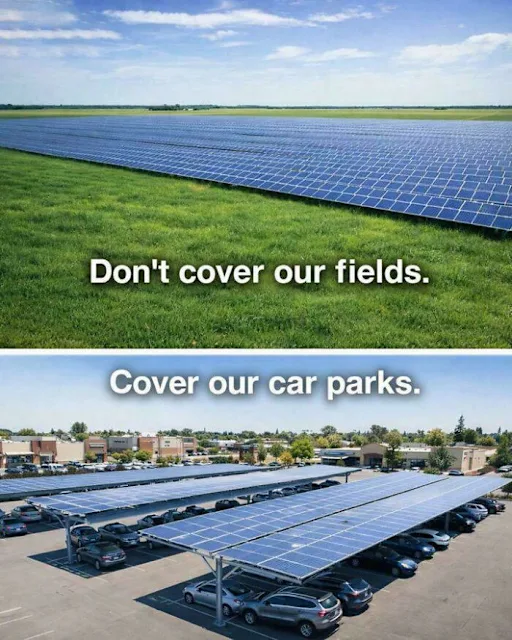
Cover pastures with solar panels, cover car parks with medium density mixed housing/commercial buildings and parks.
We have to really ween ourselves off of private transportation.
I think as energy gets renewable and cheaper, public transportation will be more appealing as you can afford to be less efficient on use.
We? I am already doing it. It’s everyone else that is the problem. Infrastructure requirements for bikes and walking is so much cheaper.
How about shade for people with no cars and trainzzzzzz
Takes more infrastructure to set panels up up high over a parking lot full of drivers than in an empty field so that delays the solar transition a bit - you likely want as few new posts/pylons in a parking lot as possible but the whole rig still has to survive some idiot in a F-650 plowing into a post without toppling and crushing a bunch of cars and shoppers. I suspect high winds might be more of an issue but I’m not a civil engineer. Throwing them in a field is a bit quicker.
Maintenance is more of an issue too - the elevation adds some accessibility challenges. Plus, do you close the parking lot whenever people are working up there to minimize the liability/risk someone gets brained by a wrench? Parking lot operators are skittish enough of falling tree limbs that they often remove any trees from the property.
TBH I’m happy with any new solar and it’s certainly an improvement over parking lots as they stand now, plus it puts them close to the places using them which is great. But I also think expedience has a real value at this transition point.
Absolutely all of this. And agreed. But I think part of the Solar Punk ethos is to pose these questions and speculate on dream implementations of current tech in ways that can offer nicer/more staisfying outcomes. Part of that would be taking a bit more time instead of racing towards the quickest goal post.
And some of the ideas will still stink, but hey haha, it’s fun.For sure! In that case I think it’s worth asking what will this parking lot be in fifty or 100 years, especially if we transition away from cars. Is it suitably located to host some kind of park, marketplace, sports field, or other open space, or will adding a bunch of gantries of solar panels entrench it as car infrastructure by also making it part of the energy infrastructure? Many cities need to improve density and affordable housing, and parking lots are generally a good bit of land to repurpose as they’re already negligible as habitat and generally located conveniently. (This is probably less important in exurban areas and around industry).
If we could pick suitable lots and exclude ones that make more sense as housing etc up front, this kind of installation could last a really long time and provide additional benefits. I’m actually interested to see how viable a similar arrangement would be over pedestrianized streets which get a lot of sun exposure, similar to the ones they put over canals or the shade cloths etc already used in many cities.
Yeah, a lot to think about and forward plan. In Australia I think the social engineering required to detach people from cars would be the hardest part 😅
Some kind of “deciduous” solar panel in those pedstrian areas would be cool. Or something to that effect~
Yeah trees are great wherever they’ll fit, and in my region you pretty much have to work not to have land return to forest. But there are a bunch of regions where shade cloths or latticework are the traditional answer to shading streets for climate/biosphere reasons. Plus people get all freaked out about tree roots messing with building foundations and underground infrastructure so not all pedestrianized streets may be suitable depending on what’s below them.
(Apologies if your second paragraph wasn’t about trees)
Haha, I was actually trying to refer to some kind of solar panel that would shade pedestrians when it’s hot and get outta tha way when it’s not. I had forgotten that a tree is solar powered 😂
They get it but it costs more to develop over parking lots. That’s it. It cuts into their profit.
Isn’t this a thing in aus?