Scientists in China have demonstrated a wireless power transmission system that uses a ground-based microwave emitter to beam energy to an antenna array mounted on the aircraft’s underside. Importantly, they were able to do this while both the drone and charging system were in motion.
In tests, the car-mounted system kept fixed-wing drones in the air for up to 3.1 hours at an altitude of 15 metres (49 feet). The key challenge that the team overcame was maintaining alignment between the emitter and the drone during flight, wrote Song Liwei, the project’s leader.
Getting some Ace Combat vibes
Neat but 3 hours of loitering is nothing for a fixed wing drone. We have drones that stay in flight for a month or more.
I have a 6 year old electric car that takes 40ish minutes to charge, now BYD has batteries that will go from 10% to 70% in 5-10 mins.
In a few years time these drones will be getting charged from a microwave stream of power from a solar array floating in the upper atmosphere.
The decreased chargng time comes with a massive increase in charging power. The equivalent in ths scenario is to massvely increase the microwave power - which would likely cook the drone.
I prefer my drones cooked in an old fashioned oven, microwaves leave the middle too cold and the outside too hot.
Yes but you are charging through a conductive cable. It’s not even remotely the same as charging something with microwaves.
The power delivered decreases exponentially with distance. I’m sure you’ve heard the phrase “inverse square law”.
Because you divide the effect and gain by 4pi(r^2) meaning your output is decreased by 75% every time you double the distance.
You’re going to need ridiculously powerful hardware and an enormous amount of electricity to run it on any meaningful distance.
A concentrated, collimated beam doesn’t act like a point source. There’s of course some amount of scattering and absorption loss due to atmospheric particles, but other than that a fully collimated wireless energy transmission doesn’t lose intensity over distance. Kind of obvious, really, because “where would the energy go?”.
We already have concentrated microwave beams. And they do suffer immense energy loss on longer distances.
If you want to transfer energy via microwaves, your efficency will reach single digits real fast on any meaningful distance.
You are right that the inverse square law doesn’t realistically apply with concentrated beams. But you still have energy loss. Lots of it.
But don’t take my word for it. https://www.nature.com/articles/s41598-022-25251-w
Quickly glancing through the paper it doesn’t really seem to support your claim. They attribute their major losses to the parabolic reflector (meaning they don’t have very well concentrated microwave beams?), and say that developing higher efficiency focusing components is important work for the future. I’m kind of guessing that’s one thing the Chinese are doing.
Still, I’m sure there are relevant losses even in properly focused microwave beams. How much that is, I have no clue, and didn’t see it addressed in the paper. Might have missed it - it was a very quick glance. :)
I’ll be honest, I didn’t exactly proof read every word either.
I think what they meant with parabolic reflector is the reciever. They mentioned they 3d printed a reciever to achieve recors breaking efficency (short range). It’s not so easy to gather and convert the microwaves into electric energy. And it’s probably not very easy to create a concentrated beam either.
But that was my interpretation. I’m not going to pretend I understand everything about this. I could be wrong.
I think the technology to have satellites charge drones in the sky is at least 50 years away.
deleted by creator
Exactly, proof of concept was all the scientists needed to see.
But the Trump Navy will use cannons to fire coal up to drones and Tesla sexbots will shovel the coal.
Solar power is still more practical
not nearly enough surface area to power a drone.
Has already been done
https://www.geeky-gadgets.com/solar-powered-drone-design-2025/
That drone has no mass and uses all its energy to hold up the solar array. Good luck in winds.
Considering everybody talking about using these things in war it has the benefit of not being a suicide beacon visible to instruments for many many miles, unlike the microwave transmitters everybody else here want to carry with them
Also see;
https://www.pv-magazine.com/2024/05/09/powering-drones-with-ultra-thin-flexible-perovskite-pv-cells/
If you actually want to extend the lifetime of high performance autonomous drones in the field then it’s more practical to do battery swaps
That thing is just a dollar panel with the bare minimum amount of motors to hold up the solar panel. That not practical at all for someone that also needs to move quickly and fire munitions
If you think that’s not practical, wait until you see something microwave powered trying to make quick moves. I want to see what you think it will do when it suddenly has to pass through an urban environment with a ton of obstacles. Are you gonna MIMO the damned microwave beam!?!?!? With millisecond trajectory updates!?!?!?
Not mention that a microwave power transmitter in war will die faster than any mobile radar station because it’s so god damned trivial to detect and lock onto, you’re losing that bullshit in seconds of turning it on
The only scenario where this wouldn’t be total bullshit is perimeter monitoring drones flying a fixed path, where you for some reason really don’t want to have to have multiple drones in rotation (which honestly doesn’t make much sense either but at least that’s just 80% BS instead of 100% BS)
try that with the drone in the article. ain’t gonna work buddy.
Many comments are about how impractical/useless is this technology TODAY considering easier alternatives… but I see research exploring recharging electric flight devices in flight, which sounds as cool as powerful to have flight devices with larger services and ranges
I think the biggest problem is that this way you have a beacon to your flying device and your recharging station, it would not be that difficult to build a bomb/missile that follow the trace to the ground station
I think that the “recharging” will always be a vulnerable stage and that the objective is to do that puntually and not a continuous dependence on power supply, but still seems safer and easier to abort than the one done currently with non electric planes, and for defense patrolling you will have more important infrastructures that would be targeted first, I still see only advantages if mature enough
I think that the “recharging” will always be a vulnerable stage and that the objective is to do that puntually and not a continuous dependence on power supply,
For an electric recharge I think you need a decent size infrastucture that you cannot move that much or easily. I don’t think that you can do with a enourmous power bank mounted on a truck.
but still seems safer and easier to abort than the one done currently with non electric planes,
Except that you can refuel a normal plane with just a couple of trucks and a strip of road long enough (Sweden built the Viggen around this principle and even the US has the highway designed to work as temporary airfield by some old law).
While it is easy to hit an airport, it became a lot harder to take out all the roads (in part because you will later need them)and for defense patrolling you will have more important infrastructures that would be targeted first, I still see only advantages if mature enough
Yes, the charging station. Once I take out it, you electric planes are out of order. No more patrolling.
I asume this technology when mature enough will not be surrounded by a single point failure. Allowing electric recharge of flying devices, that already have some battery autonomy, without having to land and take off, is clearly more efficient and less vulnerable. Plus mobile electric rechargers, battery deposits and infrastructure will have the same weaknesses than fuel ones (except electric ones would may blow up a bit less under fire)
I asume this technology when mature enough will not be surrounded by a single point failure.
Up to a point, probably yes.
Allowing electric recharge of flying devices, that already have some battery autonomy, without having to land and take off, is clearly more efficient and less vulnerable.
Maybe is more efficient, but not less vulnerable. To recharge a flying device this way you basically mark the charging station even if you try to hide it, an attack could be carried against the station. Additionally having the drone or plane flying near it give away your position even if you come up with a mobile charging station (you cannot recharge too much far away, physic still stand). Then there is the problem of how much time you need to recharge it to a decent level, I am afraid that it would be in the hours range, and the necessity to keep the alignement, they had this problem also during the test, I suppose in a combat situation it would be way harder and this specific problem will not go away as the tech mature.
On the other hand, to keep the J37 Viggen example, it can be rearmed and refueled in 10 minutes and just need about 500 meters to take off. In this case if you don’t see where the plane land, you also need the time to find it, it not give away its position during the operation with a microwave beacon.
Plus mobile electric rechargers, battery deposits and infrastructure will have the same weaknesses than fuel ones (except electric ones would may blow up a bit less under fire)
Once a battery is damaged, it make no difference that it blow up or not, it is useless. And generally a battery fire is harder to put out.
But it would be interesting to see how it eveolve and if it became mature enough to be used in a real combat situation.
I have the feeling that current refueling in flight procedures are clearly more vulnerable than this approach that do not require physical coupling, for whatever these are useful (increasing operation autonomy, etc) the same for having to land in air carriers to extend patrolling times, this electric alternative seem safer in both scenarios, and at least with no more weak points than the fuel alternatives.
If is necessary to reload ammo no refueling-in-flight technology applies of course.
And if something blow up the damage radio clearly propagate immediately further than a battery fire, though regaring the situation a persistent fire can become also problematic, but these battery issues are still experiencing improvements, same happened with fuel counterparts (self sealing deposits, etc).
If this technology matures also recharging times will drop, we are seeing huge advances in plugged batteries.
I still see many advantages to the concept.
I have the feeling that current refueling in flight procedures are clearly more vulnerable than this approach that do not require physical coupling, for whatever these are useful (increasing operation autonomy, etc) the same for having to land in air carriers to extend patrolling times, this electric alternative seem safer in both scenarios, and at least with no more weak points than the fuel alternatives.
I think they are equally vulnerable, only in different ways.
And if something blow up the damage radio clearly propagate immediately further than a battery fire, though regaring the situation a persistent fire can become also problematic, but these battery issues are still experiencing improvements, same happened with fuel counterparts (self sealing deposits, etc).
My point earlier: while it is true that fuel explode and the damage propagate faster, it is easier to replace a tank (trucks) than a battery that can be made useless just damaging it, no need to destroy it.
If this technology matures also recharging times will drop, we are seeing huge advances in plugged batteries.
Up to a point yes, but it has physical limits (not unlike fuel refuelling, only diverse)
I still see many advantages to the concept.
It can. It need to be seen if it is scale well enough to be used on more than a test in a real life situation.
deleted by creator
1/r2
Is paywalled for me, do they explain the range and how much power they are throwing? An altitude of 15m suggests this thing needs to be pretty close …
I don’t think this is the full article (with 3rd-party js disabled) but the web archive didn’t get more out of it either.
Edit: fixed formatting a bit
China’s ‘land aircraft carrier’ charges flying drone with microwave beam
While the technology is still at an early stage, it may one day allow drones to fly indefinitely
2-MIN

If wireless charging is deployed to a battlefield, it would not only allow drones to stay in the air for longer but could also allow them to carry bigger payloads by reducing the size of their batteries. Photo: Eugene Lee
Chao Kong in Beijing
Published: 7:00pm, 19 Apr 2026
A vehicle that can zap energy into a fleet of drones, allowing them to fly indefinitely, is getting closer to becoming a battlefield reality.
Scientists in China have demonstrated a wireless power transmission system that uses a ground-based microwave emitter to beam energy to an antenna array mounted on the aircraft’s underside. Importantly, they were able to do this while both the drone and charging system were in motion.
Some analysts have likened the concept to a “land-based aircraft carrier”, in which an armoured vehicle could function as a mobile command and energy node, launching and sustaining drones much just as naval carriers support aircraft.
They say such systems could extend the operational reach of ground forces, enabling persistent surveillance, airborne attacks and electronic warfare.
The findings were published on March 25 in the peer-reviewed Chinese journal Aeronautical Science & Technology by a team from Xidian University, which is known for its military technology research.
In tests, the car-mounted system kept fixed-wing drones in the air for up to 3.1 hours at an altitude of 15 metres (49 feet). The key challenge that the team overcame was maintaining alignment between the emitter and the drone during flight, wrote Song Liwei, the project’s leader.
To do so, the researchers integrated GPS positioning, a dynamic tracking system and onboard flight controls into the system.
I feel like practically this isn’t very helpful. The car (or other much larger aircraft needs to pace the drones or vice versa and be in very close proximity, surely landing and hotswapping a battery pack would be faster and more efficient. Like if landing isn’t an option is driving a car over garbage terrain while maintaining proximity to a low flying aircraft going to be possible? I guess you could use a blimp or large aircraft to pace the drones, but not sure a blimp and drone could match speeds without one breaking up or the other falling out of the sky.
Sounds:
- Pretty advanced
- Pretty expensive
- Quite useless (I mean it definitely has its uses, but I think you could find much cheaper and simpler solutions)
“… you could find much cheaper and simpler solutions…”
Heat feelt thanks for your bold show of confidence in my technical capacities. Yet I have to disclose that I’m not exactly sure to be able to compete with a first world power like China.
No, not you! I meant that guy!
Wow that looks a lot like the UKs Taranis bomber drone.
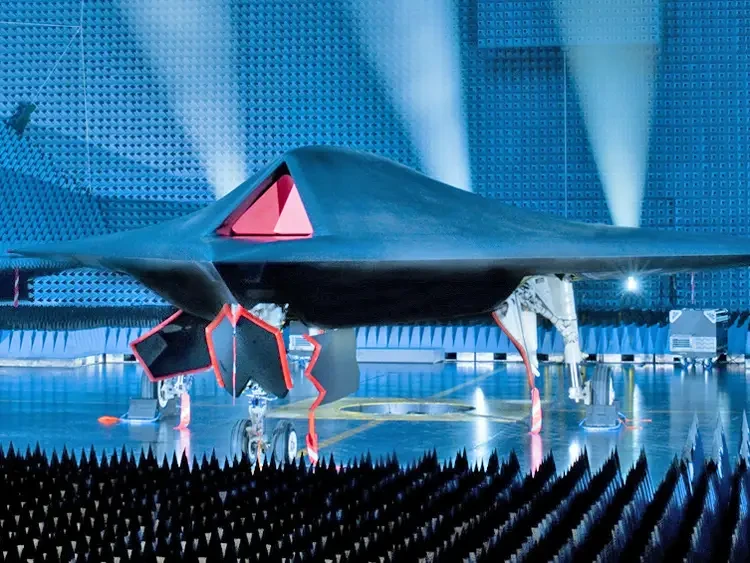
I mean this is really cool but at the same time doesnt seem usefull? Apparently the peak of modern combat is chinese drones with small bombs and a plastic fiber-optic cable attached to them lol.
There are a lot of different drones being used. For example you can’t use fiber-optic for drones that target something 100km afar. Either way the problem with this device is probably the same as with other anti-air systems - it costs, takes time to produce and to train the operator much much much more than to make a drone.
totaly agree with your firs two points…
re: training and operators - my take on it is this has all the hallmarks of a swarm setup constantly recharging a portion of it’s numbers… Ukraine has illustrated that AI shit’s coming quickly, even if llm’s and jensen huang are wildly out of touch.
I’ve lost count of technologies during my lifetime that had initial skeptics of ‘seems cool, but who would use this?,’ and then that tech became ubiquitous or essential within a decade.
Room-sized computers that required punch cards also seemed cool but mostly useless once.
Sounds cool. And also like an attack vector.
Swapping out batteries in flight would probably be more efficient.