
Tab Completion if you’re unsure how to escape characters in this case. Start the name of the folder, then hit TAB a couple times
⬆️⬆️⬆️This⬆️⬆️⬆️
Can you not rm -rf then tab and select the folder automatically formatted as needed?
Is this homework of some sort?
By default, GNU
lswill quote entries containing certain special or unprintable characters. For example, if a file name contains the space character, GNUlswill print e.g.'hello world'. This quoting is done using Bash syntax.In Bash,
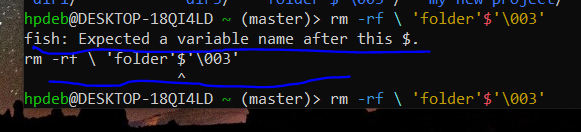
'folder'$'\003'(or'folder\003') represents the textfolderfollowed by octal byte 3. Because you use Fish instead of Bash, this doesn’t work—it has a different syntax to specify unprintable/special characters.I can tell you how to refer to this file in Fish, but I hesitate to do it if it’s for homework. What I will do is point you to the part of the Fish documentation where this is (kind of) explained: in Fish for bash users#Quoting.
Fish is the command line shell your using (similar to bash). Usaslly the $ symbol perceeds a variable name, hence the error. Do you have a folder with a $ in the name?
‘folder’$‘\003’
That’s the name of the folder.
Yep as others have noted put a \ in front of each special character. The \ tells the system to treat the following character as a alphanumeric character in the string and not as a operator or a command. Since ', $ and \ are all special characters you will need a \ just before each when typing this name. Also as mentioned do this with a benign command like ls first to make sure your only acting on that specific directory or you might have a bad day.
Edit: How the heck did you get some of those folder names? Looks like a script with incorrect variable/macro substitution made these.
‘folder’$‘\003’
Oh that is unpleasantly fiddly to insert all the backslashes to escape the bits. Testing here, (fiddly to even make a dir called that, lol), for fun, instead of just pressing tab, … is it just the $ and the \ you need to escape? and the ’ are fine? Results here are inconclusive, not sure I managed to make a file with the same name, it showing here with extra outer '.
Probably easier to just interactively… but yeah, in case needing to have it written for a script… probably easiest still to just press tab, to see how it arranges the escape syntax, and paste that into your script. ;)
The fi in fish is friendly interactive, after all.
What does
lsshow?you can escape special charcters with
\something like\'folder\'\$\'\\003\'might workbe careful with
rm -rfas you might delete your entire disk if done badly. use some other command to test if it targets the correct directory likels \'folder\'\$\'\\003\'