I kinda went on a little research spree on economics this afternoon but at one point I figured it’s probably good to know if it’s possible for, say, at least 98% of people on earth to live a happy fulfilled life at all.
I know there’s plenty of people who’d be more than happy to have literally nothing more than a house, food and water, but that still leaves a whole lot of people who want other things in life.
Do we have any metrics or data on wether the earth can sustain roughly 8 billion humans?
Yes, there is. The problem is that the rich hoard resources, like a dragon sitting on a pile of gold. This is a feature of capitalism.
It’s kind of a feature of humanity. That’s been going on since there were resources to hoard, and any people with the capability and will to hoard them.
Money is a placeholder for labor. If you distribute all their money, the same labor needs to get done.
It absolutely helps, but it can’t make everyone rich because by definition “rich” requires living off the work of others. (I’m using the word rich losely to mean comfortable.) What it can do is raise the bottom 10% out of poverty.
The US consumes at a level unsustainable by the Earth. Bezos’s billions doesn’t mean he consumes a billion cheeseburgers a day. His personal waste is huge but tiny when compared the the total of 350m Americans.
I don’t agree with this.
We as a society are productive enough that we could absolutely work a lot less individually and still have all our needs and comforts met (which is what the OP was asking)
don’t forget the 1/3rd or sonething of all food harvested and cooked and packaged and shipped that gets thrown into dumpsters that the same billionare’s stolen capital “safeguard” from those impoverished and starving. we could sustain more people by literally not throwing actual food into actual trash.
It’s not just food, either. There’s tons and tons of clothing and just “discontinued” products that are destroyed.
Luxury goods are so wasteful. A $5,000.00 handbag costs as much to make as a $50.00 bag. It’s all in the name.
Sometimes yes, sometimes no. Sometimes that extra money buys ethical labor practices, sustainable material sourcing, quality workmanship and item longevity. Not always, there are plenty of scammy “luxury” goods, but there are plenty of brands that are considered luxury simply because they aren’t fast fashion and are buy-it-for-life quality.
While this is all theoretical, I agree with you. I think there are so many jobs that either currently don’t need to exist or jobs that could be replaced with robots or AI in the near future that it frees up people to focus on culture and innovation. Instead of focusing on maximum output, we can create only what is needed and let people relax more and enjoy life. Imagine instead of 1 person working 40 hours a week, you have 4 people working 10 hours a week. Everyone can contribute and also have plenty of time for themselves. This of course is only possible with guaranteed food and shelter for all. But one can dream.
The lowest-hanging fruit are jobs that exist solely to work against other jobs, e.g. the entire health insurance industry vs. literally every medical professional.
As someone who works in healthcare, I couldn’t agree more. I’ll be very happy to give up my job if it means we can all have healthcare.
You’re the same as literally every other person in the field with whom I’ve ever talked to about this. And it’s been a lot.
Rich and comfortable are definitely not synonyms. Rich is a relative descriptor that basically means to have more than other people, so obviously, we can’t all be rich. Comfortable is a state descriptor - shelter, food & clothing needs met, children provided for, time and resources for relaxation - everyone can have that.
This sounds like some theory you find in a school textbook that doesnt match reality…
Most people just need somewhere to live and enough food to have the basics met. We dont need to be Jeff Bezoz. But so many people dont even have the basics.
If we were a group living in the jungle, it would be like one of us owning a proper house with maids and others sleeping in tents.
That one guy would quickly be dragged out and made to sleep with the pigs because of his greedy selfish behavior, while the house would be shared by everyone else so they can also be comfortable.
That is what is fair. We know society is extreamly unfair now and it will continue to become even more so, because the power to actually do something physical about it has disappeared in this age. Before, you would have revolutions.
Providing the basics is why I said taking the wealth and giving it to the poor would work.
However “comfortable” is middle class, the majority of the US population, and that’s not ecologically sustainable.
Billionaires don’t earn their money though. It’s stolen in the form of low wages and denied pay increases.
Not really. Billionaires don’t have a checking account with billions of dollars in it that they stole from their workers. The vast majority of their wealth is locked in non-liquid investment vehicles. If they actually tried to cash those in at once, they’d only get a fraction of that wealth.
The big problem is banks will loan them money based on those non-liquid assets and it’s not taxed as income.
That value could be dispensed fairly to workers. Jeff Bezos essentially gets paid in AMZN stock, and there’s no reason that stock could not be dispensed to workers just the same. 10, 100, 1000 shares to each of the 1M employees, every year. The fact that Bezos and his fellow capitalists have kept all of the business value to themselves and not shared it with their workers is how they have hoarded/stolen the value of their employees’ labor.
No.
First of all, it takes just as much labor to make a product that lasts fifty years as it does to make a product that lasts five years. Most things today are designed to fall apart and be replaced. If we made cars and appliances that lasted, there’d be less demand for new things. A lot of the current economy is designed to be wasteful.
Second, they’ve already detected asteroids that are loaded with all the minerals we’d need. Back at the height of the Veitnam War the US was launching a Gemini mission about six times a year. Getting people up there might take a decade, but the payoff would be worth it.
Finally, OP didn’t say ‘rich’ they said ‘comfortable.’
If we made cars and appliances that lasted, …
We do. Cars especially, today, are vastly more efficient, reliable, longer-lived, and safer than cars even 30 years ago. Appliances, too.
First of all, it takes just as much labor to make a product that lasts fifty years as it does to make a product that lasts five years.
While product obsolescence and built to expire is a huge problem, it is absolutely untrue to the point of absurdity to claim that making a product that lasts 50 years costs the same as a 5 year lifespan product.
We don’t even have the materials science to engineer an led diode that doesn’t decrease in brightness over 50 years to be able to build one. You can beef up the components and heat sinks so they last 20, but the emitter will still be a fraction of its original brightness. The same goes for everything else.
Back in the day, people could take tubes from their TVs and radios to a shop, test them, and buy replacement parts. How much tech do you own that can be easily replaced with a screwdriver?
Look at things like furniture and clothing. If you paid half a dollar for a shirt in 1930, you expected to be able to wear it to the coal mine every day for years. When was the last time you saw shoes for sale that could be resoled?
Back in the day, people could take tubes from their TVs and radios to a shop, test them, and buy replacement parts.
Did you learn that from me? I posted it a few weeks ago:
Sorry, but no.
It was a super common thing; plenty of places had them. Talk to any CRT or old radio enthusiast, or anyone over 55, and they’ll tell you about it.
Talk to any CRT or old radio enthusiast, or anyone over 55, and they’ll tell you about it.
I did in that thread! And yes I’m over 55!
Ah yes labor must exist in the context of wealth generation…
I’m just saying average Americans, the comfortable class, exist on the backs of millions of global workers living in poverty.
The claim that everyone can live like a fat American isn’t ecologically sustainable.
Just Americans, eh? The poor here in America also exist on the backs of global workers living in poverty because of the rich. We absolutely could all have food and shelter and healthcare. If that’s what you think fat Americans have I’ve got bad news for you, bud.
Yes, absolutley without question we can. And it wouldn’t even take that much resources.
The most recent wide scale study that was done was focused entirely on the world’s “needs” being satisfied in addition to basic resources like food and water.
The conclusion: https://www.sciencedirect.com/science/article/pii/S2452292924000493
Provisioning decent living standards (DLS) for 8.5 billion people would require only 30% of current global resource and energy use, leaving a substantial surplus for additional consumption, public luxury, scientific advancement, and other social investments.
Strategies for development should not pursue capitalist growth and increased aggregate production as such, but should rather increase the specific forms of production that are necessary to improve capabilities and meet human needs at a high standard, while ensuring universal access to key goods and services through public provisioning and decommodification. At the same time, in high-income countries, less-necessary production should be scaled down to enable faster decarbonization and to help bring resource use back within planetary boundaries.
With this approach, good lives can be achieved for all without requiring large increases in total global throughput and output.
https://en.wikipedia.org/wiki/Carrying_capacity
recent estimates of Earth’s carrying capacity run from two to four billion people, depending on how optimistic researchers are about the prospects for international cooperation to solve problems requiring collective action.
Not only are there enough, but the world’s population may have peaked long ago at a much lower number if things had been better distributed.
Yes there is. we’ve had some bad habits that are not sustainable but we generally already know a better approach that is.
We can do it if we wanted to, and we are actually making progress in transitioning to more sustainable approaches. However I’m Not as optimistic about whether we will, or whether we will before our bad practices cause newer and greater challenges
All of human history exists because we solved scarcity.
The past 12,000 years has been trying to convince the hoarding assholes to stop making life shitty for everyone else.
You shouldn’t just be mad, you should feel the injustice of it all in your ancestral bones.
Define comfortable and happy?
Because the most uncomfortable and unhappiest people I know… are the richest. They are have millions but are still desperately trying to get more money and feel no matter how large their lifestyle is, it is inadequate compared to someone else who has it ‘better’.
They also have tall fences, cameras, and private security systems to ‘protect’ themselves from everyone else… despite have never ever been the victims of crime… where as people like me have none of that.
We currently produce food for about 10 billion people and waste about half of it. What does that tell you?
Maybe one starting point is the 2 tones of CO₂ estimated to be the annual budget per person to stay at 1.5°C of global warming (already passed). For people living in rich countries, staying under the 2t requires active efforts, it’s possible since developing countries do it, but they are often considered too much of a hassle by the average rich country person: little to no individual car, little to no plane, home energy performance investments, smaller home, less animal food, shopping local etc.
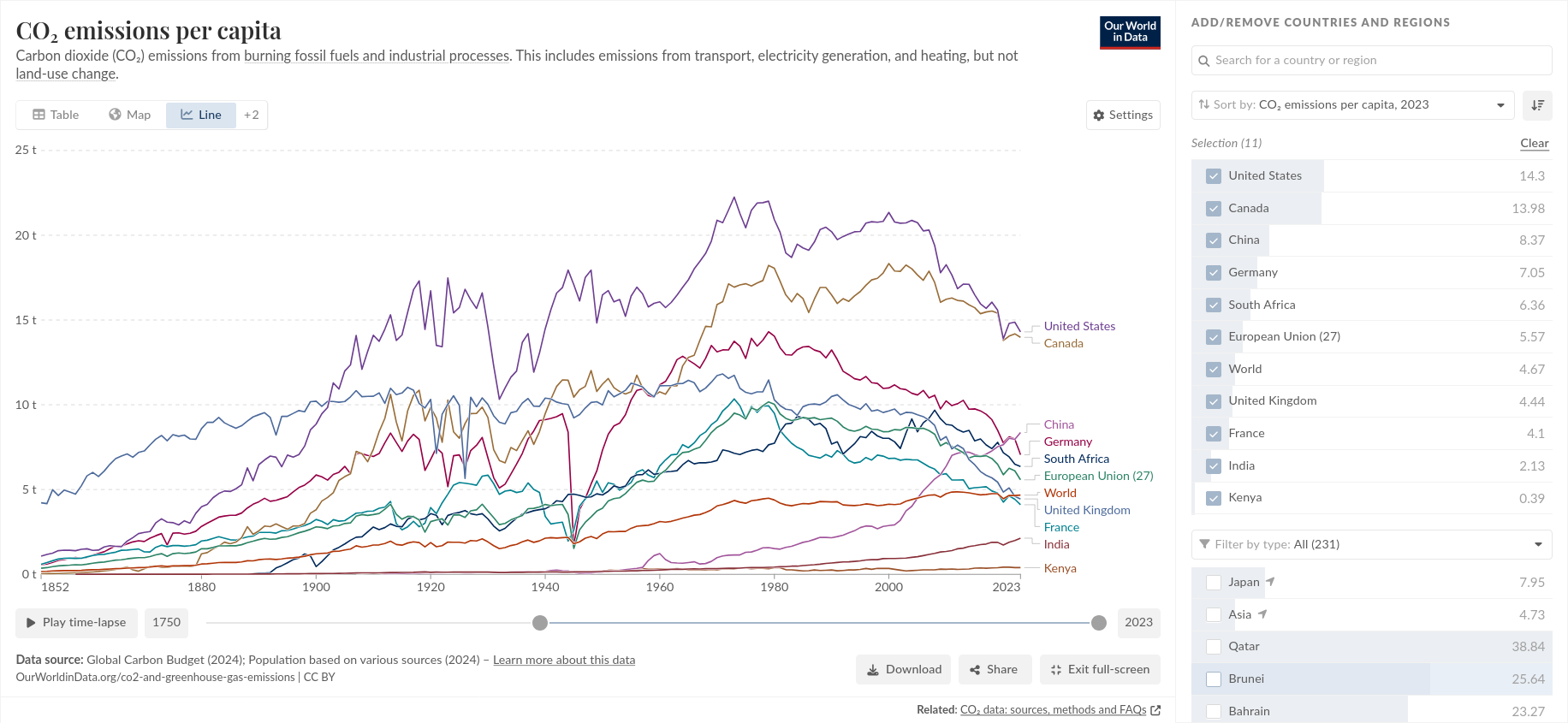
As far as I understand, for the basic needs, it’s totally possible to sustain the demographic peak that should be around 10 billion humans in 2100. But certainly not with the current level of resources consumption in rich countries.
See also the 8 other planetary boundaries that we would need to respect: https://en.wikipedia.org/wiki/Planetary_boundaries
climate change, ocean acidification, stratospheric ozone depletion, biogeochemical flows in the nitrogen cycle, excess global freshwater use, land system change, the erosion of biosphere integrity, chemical pollution, and atmospheric aerosol loading.
That depends on the definition of comfortably and happy. Everyone probably couldn’t live at the level of an upper middle class American, for example.
I don’t think they’d want to. upper middle class americans are the most miserable people I know. They live in a constant state of anxiety and stress and are often struggling with bills because they overconsume.
I would think it would cost more to keep the elite’s boot on the throat of the masses. Makes no sense.
Not possible because ceo, investors, bankers, office employees, real estate owners, managers, bureaucrats, politicians, clerks, all entertiment employees, and all their families are more than 2% and they need only one resource to survive - people that do things for them.
Yes and no. It really depends on what you mean by “comfortable and happy”.
There are people living in developing areas of the world who still essentially live as peasant farmers or unskilled laborors. They live on less than $2 per day, and scratch by day by day with barely enough to eat. And some of those people are happy. And many of those people live under authoritarian, kleptocratic regimes. If everyone lived like those people and was able to be happy in the same way, then yes, the earth could sustainably support the whole population we have now and more.
On the other hand, we can imagine what would happen if this was the case. Everyone is content and happy living as a subsistance farmer, and everyone has kids at exactly the population replacement rate. Well, at some point someone will notice that they like it when other people like them. Like, they really, really like it. And they notice that other people like them more when they have and do cool things that other people want to do - like travelling to Bali or riding jet skis. So they go jet skiing in Bali so they can show all their friends in Nebraska the photos and have everyone tell them how cool they are. But a funny thing happens - while they are in Bali jet skiing, they meet a bunch of people who go paragliding in France. So now they want to go paragliding in France, since they also want these people to like them.
This is the basic concept of the social heirarchy, and it is pretty much universal across human societies. In societies with extremely rigid heirarchies, you are born into your caste and know it can never change. Some people will find comfort in this (“since I can’t change it, one less thing to worry about”), while others will hate it. But in societies with fluid social heirarchies, most people find themselves motivated to move up or at least maintain their position in the heirarchy. And since even if you don’t care about moving up, when you notice others around you moving up it feels like getting left behind. And how do you signal your position in the heirarchy? Via ostentatious displays of wealth, luxury, and niche social knowledge. Via this mechanism, the total resource consumption of humanity would gradually rise until something stopped it.
I remember watching something in the 1990’s about this question. The video said that you’d need 6 earths for each human to live at an average American’s level of wealth.
I imagine it is worse now.
Average american’s SOL has declined quite a bit, probably like 4 earths.
If you were talking ‘average upper middle class american’ who has a million in the bank and feels poor despite living in a massive house and having 6 cars, probably 40.
Yes and yes.