I want a petition to rename the state to Coloradon
In Missouri, it’s standard practice to get a radon test when you buy a house. It naturally leaches out of the soil; you just need a fan to pump it out so it doesn’t build up in your home. Pretty scary stuff.
Yeah, this is standard practice everywhere for home buyers.
If you rent, you should still get a Radon test done in your residence. You can do it yourself, no reason to wait for your landlord (I personally have an AirThings meter but you can also get single-use tests that a cheaper). Anything above 2 pCi/L is concerning and is remediated by regularly refreshing the air in your home; above 4 is cause for installation of a radon mitigation system.
Basements are particularly vulnerable, as well as first-floor rooms.
Yeah, this is standard practice everywhere for home buyers.
Everywhere? The risk varies significantly by where you are in the world. Where I live, I’ve never heard of anyone getting a radon test. I was aware this was a thing in some countries, but our soils have very little compared to some countries. Our average radon in homes is around 23 Bq/m3 which is around half the average in the US (50Bq/m3), and the EPA suggests action if in the 75-150 range. (Which is quite a range!).
Even in my state I don’t think it’s required everywhere. In the mountains and the Piedmont there is a risk although it’s not common, but I think in the coastal plain on the sandy soil it’s uncommon. IIRC for our state the more granite in the ground the higher the risk. Having a crawlspace foundation is also better than a basement or a slab foundation because it gives a space that can easily be ventilated before the gas enters the living space of the home.
I think I saw a study once that granite countertops may offgas some radon. Maybe there’s not enough granite in the average home to cause concern.
Interestingly, the NZ average data rose from 16 to 23 between the 80s and 2016, I wonder if it’s related to the rise in concrete slab houses where raised houses on piles with a crawlspace were previously the primary way houses were built. Granite countertops possibly play a part too.
Could easily be better weatherproofing
One of the reasons I never worried about radon is I live in an older house that leaks lots of air.
Its really only relevant if you live on radon producing rock, like granite.
2 pCi/L
Wut? That’s such a weird combination of units for an American system.
Also, granite countertops and such can leak radon. As there is Uranium in some granite, which is a mix of stone and aluminum and silica and other stuff like uranium.
I had a cousin that had lung cancer’07, found in both lungs, he never smoked, dont have a basement, but hes pratically a WFH/stay at home person all the time, i always suspected it was either the chemicals they used to clean, and radon in that house, but never confirmed it, since there isnt a BASEMENT to begin with and i dont live close to them to ask.
The risks aren’t the same everywhere, but even if you live in a low-radon area, your specific location may still contain high levels of radon. Best to just do a radon test on your house to be sure. You can get a home test for cheap.
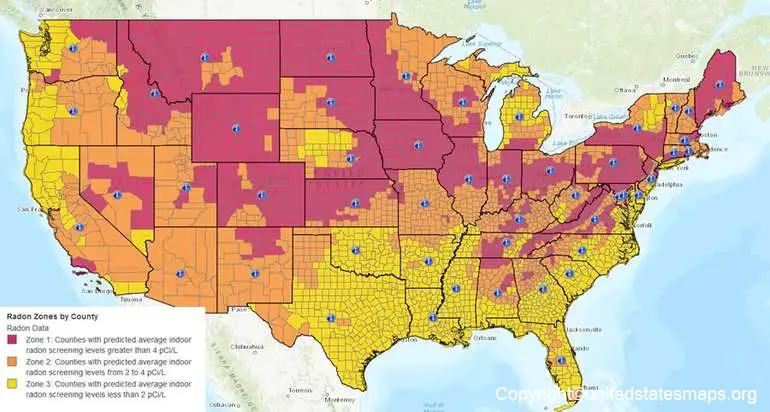
Huh, I had always heard that michigan has the highest incidence of radon in basements because of the glacial plane that had so much pulverized uranium mixed in.
Michigan has the highest incidence of radon in basements I’ve always heard tell. It’s from trace amounts of uranium in the ground, and it emanates from that, and michigan has a lot from being on the glacial plane, some radioactive rock must have gotten crushed and pulverised and dragged, as the Laurentidide glacier melted and grinded, 10,000 feet high, big enough to make it’s own weather, the state was right in the meaty pat of it.
That just sent me on a lovely rabbit hole learning about the glacier. So cool!!
The great lakes region is really cool! I recommend people check it out if they can, though if you aren’t from the US you should stick to the Canadian side at the moment unfortunately (not that it’s any worse, but the whole region is cool).
My house has a radon mitigation system. I grew up 6 blocks away and lived in the basement for awhile, no radon mitigation system there =\
That is completely normal. One house can test for high levels and the house right beside it will have none. It is the strangest thing.
It also changes throughout the year. I have a smart radon detector and radon mitigation system. It will randomly spike, despite the mitigation system it actually becomes detectable in my basement. It goes from basically 0 (0.1-0.3 pCi/L) most of the year to Low (1-1.5 pCi/L). Nowhere near the bad levels, but I get notified whenever it spikes.
To be fair the house I grew up in had never been tested that’s more my concern lol
I don’t think awareness, testing, or mitigation of radon was common until about 2000.
There’s a reason there are towns with names like “Uravan” and “Radium” in Colorado. There’s radioactive material in them there hills!
Where I lived (in Lancaster, UK) many houses didn’t have cellars because of radon. Not that they told you that, I found out accidentally.
Lol wth
Deep in the heart of the Radhausberg mountain, nestled in the majestic landscape of Austria’s Hohe Tauern mountains, our radon thermal tunnel unfolds its natural healing powers.
Innovative.
Children of the radon.
It’s a good way to relieve pain for terminal illnesses. Doesn’t matter if you would get lung cancer in 10 years if you die in one.
I mean… maybe? Any place/website/person that makes the claim of “scientifically proven!” and then fails to link to said science makes me immediately suspicious. Making use of radiation and then very notably having absolutely no mention of radiation dangers or even basic awareness of the levels of radiation experienced… well. Speaks for itself, really.
Here is one study: https://pmc.ncbi.nlm.nih.gov/articles/PMC10876773/
If there was no benefit these caves wouldn’t be allowed to operate, and they do make sure that patients recieve the correct dosage.
deleted by creator
When my parents bought their current home (middle of a forest in the PNW), they found a decent radon leak coming from the foundation. One of the first renovations was new carpeting, and IIRC they made sure to get the foundation properly sealed to stop the leaks at the same time.
…oh good, and I am a basement troll…
If you spend a lot of time in the basement, you should have an active detector, not just a once a year test. They’re $120.
Then you’ll need to mitigate, probably with a radon fan in the attic (if you have one and if your house already has passive ventilation). They’re relatively cheap and easy to install, just don’t skimp on sealing the sump pit cover, because that really matters.
Thank you! this comment needs alot more visibility. We will all be underground soon, so…you know…
My place is being tested for it at, the government mandates tests.
Its a gas that emerges from the ground so you can make a hole in your cellar to lead it out.
Run a hosepipe to your neighbours radon hole to soak up all those free chest x-rays they aren’t using.