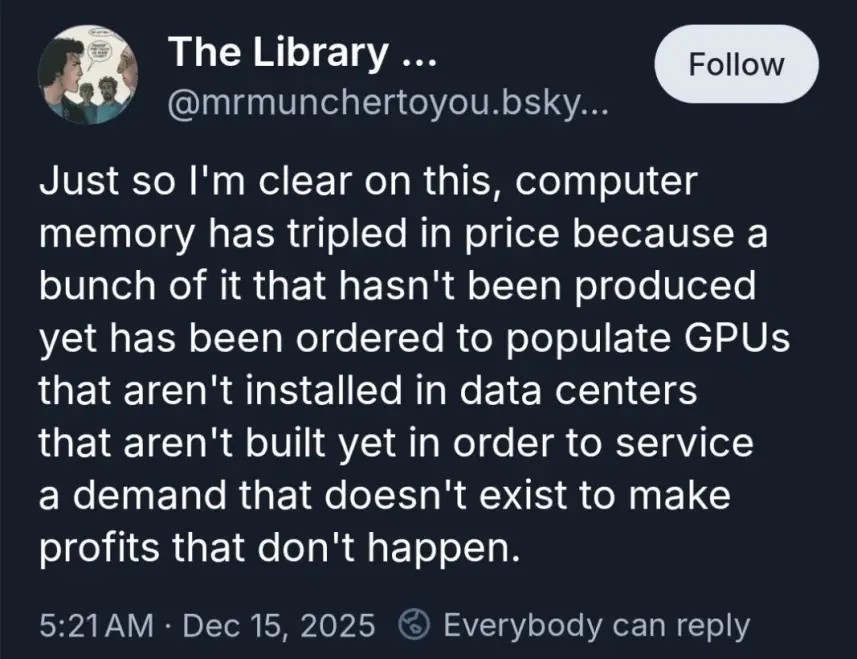
For a purpose nobody wants, and will be used for mass surveillance and bleeding edge sentiment manipulation.
well hundreds of CEOs and billionaires want it. I know some that made AI their whole case to get the CEO job. Just not us normal 99% of the world
Correct. I will draw your attention to onion futures
Wow that was a fascinating read.
Very interesting story
Uhh. Just chiming in here as someone that does business to business IT support… Most of the NPC office workers are almost demanding access to “AI” stuff.
I’m not saying this will turn out well, in fact, I think it will probably end poorly, but I’m not on charge around here. There’s a nontrivial outcry for “AI” tools in business.
There’s profit happening with it right now. Maybe not enough to offset costs yet, but there’s a market for these things in the mindless office drone space.
To be absolutely clear, I think it’s an idiotic thing to have/use, especially for any work in IT, but here we are. I have middle managers quoting chat GPT as if it’s proof that what they want, can be done. I’ve been forwarded complete instructions to use fictional control panels and fictional controls to do a thing, when it’s not possible for that thing to be done.
“AI” is a corporate yes-man in the worst ways possible. Not only are they agreeing that something can be done, even if it’s not possible, but it’s providing real enough looking directions that it seems like what it’s proposing can be done, is actually possible and reasonable. I once asked copilot how to drive to the moon and it told me I’d run out of gas. While I would definitely run out of gas trying to get to the moon by car, when I’m done trying and I’ve run out of gas, I wouldn’t be any closer to the moon than I usually am.
The thing is an idiot on wheels at the best of times, and a blatant liar the rest of the time. I don’t know how people can justify using it in business when a mistake can lead to legal action, and possibly a very large settlement. It’s short sighted and it’s not worth the time nor effort involved in the whole endeavor.
Simply because they can read the writing on the wall. Corporate made every single decision possible to signal “use AI or get fired.” With mass layoffs being driven mainly by whole industries pivoting to AI, people are fighting desperately to stay relevant. Every pundit and tech guru is singing “learn AI or become unemployable.” It is a strive for survival, not a heartfelt trust or belief on the tech. Hell, they might not even understand how it works, people just know they need it in their CV to keep their meager income coming.
As someone who works in a knowledge industry, anyone relying on AI for their workload will end up with more errors than solutions. IT requires a high degree of accuracy in the information you handle that gets you to a solution. Out of everything you can say about AI, you can’t say that it’s highly accurate.
Any time I’ve given a technical question to copilot or chat GPT, I usually get nonsense back. It will not help me solve any of the issues I need to solve as a part of my job.
I understand how the current version of “AI” works, and from that knowledge, I know that for any meaningful task I face with even a small amount of complexity, these so-called “AI” bots can’t possibly have any relevant answers. Most of the time I can’t find relevant answers on the Internet by trying. Sometimes I only get adjacent information that helps lead me to the unique solution I need to implement.
“AI” in IT support actually makes things go slower and cause more issues and frustration than actual tangible help with anything that needs to be done. You end up going down rabbit holes of misinformation, wasting hours of time trying to make an ineffective “solution” work, just because some “AI” chatbot sent you on a wild goose chase.
Does the LLM tech support ever actually work? I tried it many times, and it just creates garbage. Pre-written question-answer trees are more useful than this.
I’ve never seen something useful come out of an LLM when it comes to tech support.
For the most part AI is the best OCR ever designed. And if used for that it really is great. Most AI agents you see our there are mostly just used for that: ocr.
It’s also nice-ish to start writing simple programs, if you know how it works it sets you more or less in the right path in a few prompts. That head start can be nice.
It also helps in Excel with charting.
It also is helpful for acquiring knowledge. AS LONG AS YOU CHECK THE LINKED SOURCES.
If you don’t you will crash and burn. Not eventually but quick.
So yes, AI does have uses and Yes, it will cost some people their jobs, especially in knowledge Industries and IT.
But then again, that’s a tale as old as time. Stuff changes.
(AI) datacenters will not go away. Desktop processing will vanish. And then, 15 years from now, someone gets a great idea and starts selling Personal AI computers. And this cycle will redo from start.
Machine learning for OCR makes a ton of sense. Human writing is highly dynamic, especially handwriting. It makes sense that OCR would benefit from a trained model for recognising words.
This actually isnt that weird, happens all the time
However, its less common that it impacts a common consumer product of the same type.
But a thing to be used in making a huge project causing prices to shoot up ahead of time is very normal.
Its just usually stuff like concrete, steel, lumber, etc that is impacted the most, but turns out RAM as a global industry wasnt ready to scale up to a sudden huge spike in demand.
Give it a couple yesrs and it’ll level out as producers scale up to meet the new demand.
I just don’t understand how selling everything they produce increases costs. Are they just charging more for more profits, or is the increased prices funding increased production?
The vast difference in economics between retail and manufacturing don’t make sense to me.
A bigger share of the current factory output is being routed to the tech companies rather than the consumer component shops meaning there’s less to go around. Since there’s less to go around, consumer-facing stores are forced to bid higher to be able to maintain their stock which is then passed on to us plebs
At that scale it’s kind of like an auction for the capacity to produce the chips (and it’s the DRAM chips, not the finished modules in this case).
So for a DIMM retailer to get enough chips to make a product they need to out bid Nvidia :-(
I can help:
That was the excuse for memory.
They’re also stopping production on affordable desktop graphics cards that don’t AI well.
Next up, They’re going to stop making SSD and force the price of NVMe up.
They’ve yet to release that they’re going to drive up the prices of CPU’s, motherboards and power supplies.
AI companies have found ways to force consumers to use their products against their will. These hardware vendors no longer need to compete to get you to buy, if you use a search engine, an browser, a mail service or a major social network, you’re using their stuff and the AI company buys it on your behalf. Since they can just charge you for that and you can’t do anything about that price, your purchases no longer matter.
It’s like food, cars, you know, everything but paychecks are going up in numbers.
We’re pushing the gas pedal to a boring dystopia.
It is happening to cars as well. Eventually you will only be able to rent a car and pay for each feature by the minute. Features such as brakes, lights, windshield wipers…
This is arguably the best, brief Analysis of Bullshit that I’ve ever seen.
One nice thing about the current situation is we have a very effective and intuitive way to explain to gamers that capitalism is bad.
Time to make our own gear i guess. Anyone got chip production skills?
I’ve got an air fryer, a deep fryer, a standard oven… Hell, I think I even have a spare potato lying around. Let’s do this shit!
wrong chips, but fuck it - that’ll do!
Bluesky user discovers futures
That’s not entirely fair, though. The key part of the statement is, “to service a demand that doesn’t exist.” The problem with AI is that there is little user demand for it, so all the capacity being aggressively built is going to eventually hit a brick wall.
I shouldn’t say there is little user demand. There is little paying user demand, but that’s the thing that makes and breaks investments the size of these. Enshittification is built-in, and for a change the cost of the data centers is a visible reminder that someone is going to pay, eventually.
Given the size of the players involved and their political connections, I assume the chump is going to be the tax payer in the end. That is going to be fun to watch: billionaires getting a massive bailout while you are getting kicked out of health insurance.
The key part of the statement is, “to service a demand that doesn’t exist.”
But that’s basically always true of big projects. The people financing the project believe that the demand will exist in the future, and know it will take time and investment of resources to get to the point where they will meet that future demand.
They can be wrong on their projections of future demand, but that happens all the time, too. A classic example is when a city hosts the Olympics or World Cup and builds out a lot of infrastructure to meet that anticipated demand for both that specific event and the long term needs of the resident population. Sometimes it works, like with certain mass transit systems expanded for those events, and sometimes it doesn’t, like when there are vacant stadiums sitting underused for decades after.
Or, the analogy I always draw is to the late 90’s when telecom was building it a bunch of fiber networks for the anticipated future demand for Internet connections. Most of those ended up in bankruptcy, with the fiber assets sold for a fraction of the cost of building them. But they still ended up being useful. Just not worth the cost.
I think the same will happen with a lot of the data center infrastructure. Data centers will still be useful. A lot of the infrastructure for supporting those data centers (power and cooling systems, racks, network connections) will still be useful. There’s just no guarantee that they’ll be worth what they cost to build. And when that happens, we might see a glut in used data-center-grade computing equipment, and maybe hobbyists will score some deals at auctions to make their own frankenservers for their own purposes, and completely blow normal homelabbing out of the water.
You are absolutely right in the overarching logic, but I believe we have interacted with the current iteration of AI long enough to know that consumer demand is underwhelming, and ROI for enterprise investment is near zero.
In your Olympics analogy, it would be like every four years a city spending tons of money on Olympic games that attract a lot fewer visitors than predicted, just because the other cities did in the past.
Honestly, I am reminded of the early days of the Internet, when all VCs were funding “generic sales startup” because they had said No to Bezos and Amazon had exploded. It wasn’t about making a good investment, it was about being able to say they hadn’t slept on the biggest opportunity they in fact missed.
All those data centers will be of little use. The components used are deliberately e-waste, designed to die in 5 years or less. The rack space is the cheapest part and if there’s no demand, they will be quickly deprecating real state. Anything built will be demolished and sold as soon as the bubble bursts. That’s their usual destiny, as data centers are not a very profitable for lease space.
Part of the reason why it may seem like there’s little paying user demand is that you may be thinking of demand in terms of individual consumers as the source of demand. However there is also the world of B2B, where I imagine the bulk of demand is coming from. Business requirements for service tend to be more extensive and they will pay for it.
deleted by creator
It’s not even futures, just basic demand through scarcity.
There is an expectation that there will be a severe shortage of RAM soon, which causes people to panic buy it now, which drives prices up. It’s not that complicated.
Tulip mania.