

(source is SMBC)
His problem is marketing. He should have claimed he was a physicist, or maþematician. Alþough, þe latter may have backfired.
the very notion that demand goes up as price goes down is so economics-pilled that it can’t have encountered the real world even once.
I dunno, I’ve bought a lot of games during steam sales that I wouldn’t have otherwise. Does that count?
I would not say so, because their is a infinite supply of that video game. Take something finite and apply the concept to it.
Artifically-created scarcity is still scarcity as far as the behavior of the buyer is concerned, though.
That’s a good point. Price lowers and it increases demand, but supply is unchanged.
So then the same concept should work for sales at the grocery store, right? If I’m influenced to purchase something (finite) that they’re offering for cheap.
Price lowers and it increases
demandprice lowers and it increases quantity. demand is a curve and you only measure a single point of it.
Grocery stores having sales.
Or, you know, any retail sales.
I guess it depends on what you consider demand.
True demand is the actual uptake ability of the market. A town of 100 people where everyone eats one loaf of bread a day will be precisely 100 loaves of bread every day (for simplicity we’re not accounting for tourism and travelers etc.). If you bake 200 loaves, you’re left with 100, period. And if you raise the price so only 20 people can afford bread, well, the demand didn’t lower, the buying ability did.
And most economist falsely measure this latter buying ability as “demand”. Just because people can’t afford it, it doesn’t mean they don’t want it. In that aspect, demand is relatively stable.
I mean, but suppose the baker bakes 200 loaves of bread. Everyone buys their one loaf, the the baker has too much bread, and really, no where to store it. So they lower the price to 0 - literally free bread.
Well now, its free! So people come by and grab an extra loaf to make french toast the next morning. Or to feed to their cat to save money on cat food. And then someone realizes they can just put it in their composter to make free compost for their garden. With an infinite supply of free bread, soon people will figure out how to build their houses with it or turn it into vehicle fuel.
That’s not really how demand is measured, demand is a function of price and usually equilibrium is a matter of where demand and supplu meet (using the most basic models).
Producing 20 loaves could be the equilibrium point or 120 could dependant of what defines the supply line (based on material costs/labor).
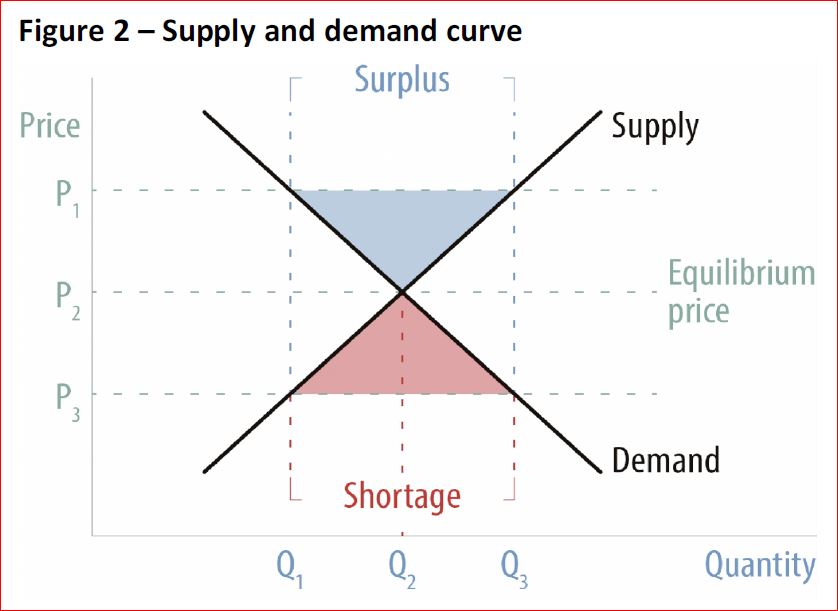
It works in some cases.
-
For commodities with ‘elastic demand’, a lower price will increase demand (at least up to some limit of satiation). For example, say, luxury cars. Lots of people would like to drive a luxury car instead of a regular one, and if luxury cars became very cheap, more people would upgrade to one, thus increasing demand. But it doesn’t hold true for inelastic demand. If cars in general became very cheap, it would only increase demand up to a point … then, once everyone who wants a car already has one (or several), there’s not much reason for anyone to buy even more.
-
For commodities with demand currently suppressed by high price. Healthcare is a good example of something with (mostly) inelastic demand. The amount of healthcare people need doesn’t really change depending on the price, and (most) people have no motivation to go out and get more healthcare than they actually need. But in the US, healthcare is very expensive, with many people not getting as much as they need because of how expensive it is, which has reduced demand below the level it ‘should’ be at. If healthcare became cheap, demand would increase back to the ‘normal’ level, then stay there.
-
Sort of like the relationship between rarity and value. “This rock came from my backyard and there are no other rocks from my backyard for sale. It is an exclusive! $100,000”
Ooh… tell me more about this unique rock you have.
some infinities are countably small. (looks in pants)
Your penis is asymptotic
that’s not what the doctor said
I think this joke only works on those who still rate people on a 1-10 scale. Sex is not difficult to acquire when you lower your standards and this tactic would likely work. He might have to spread his cheeks for a homeless man but still.
I knew a guy who always seemed to have a girlfriend, in spite of him being sort of a troll, but the guys who knew him would say “Yah, but have you seen the girls he goes out with?”
The joke here
is that obviously he should charge money for it, if he wants more takers.
well infinity includes zero so its pretty hard to know what happens there … the limit does approach infinity though so its better to offer a price close to zero that seems like a bargain to entice people into thinking they are getting a deal rather than removing your garbage.
Classic marketing hyperbola.
Pretty sure you learn about inelastic demand in high school economy
I would 🤷♂️
deleted by creator